What a Forester Owes a Fire
Three years after the CZU Lightning Complex Fire, the hills above Bonny Doon are beginning to recover. But recovery has not unfolded the way many of us expected.
Kyle D. Peczkowski
Board Certified Master Arborist & Urban Forester
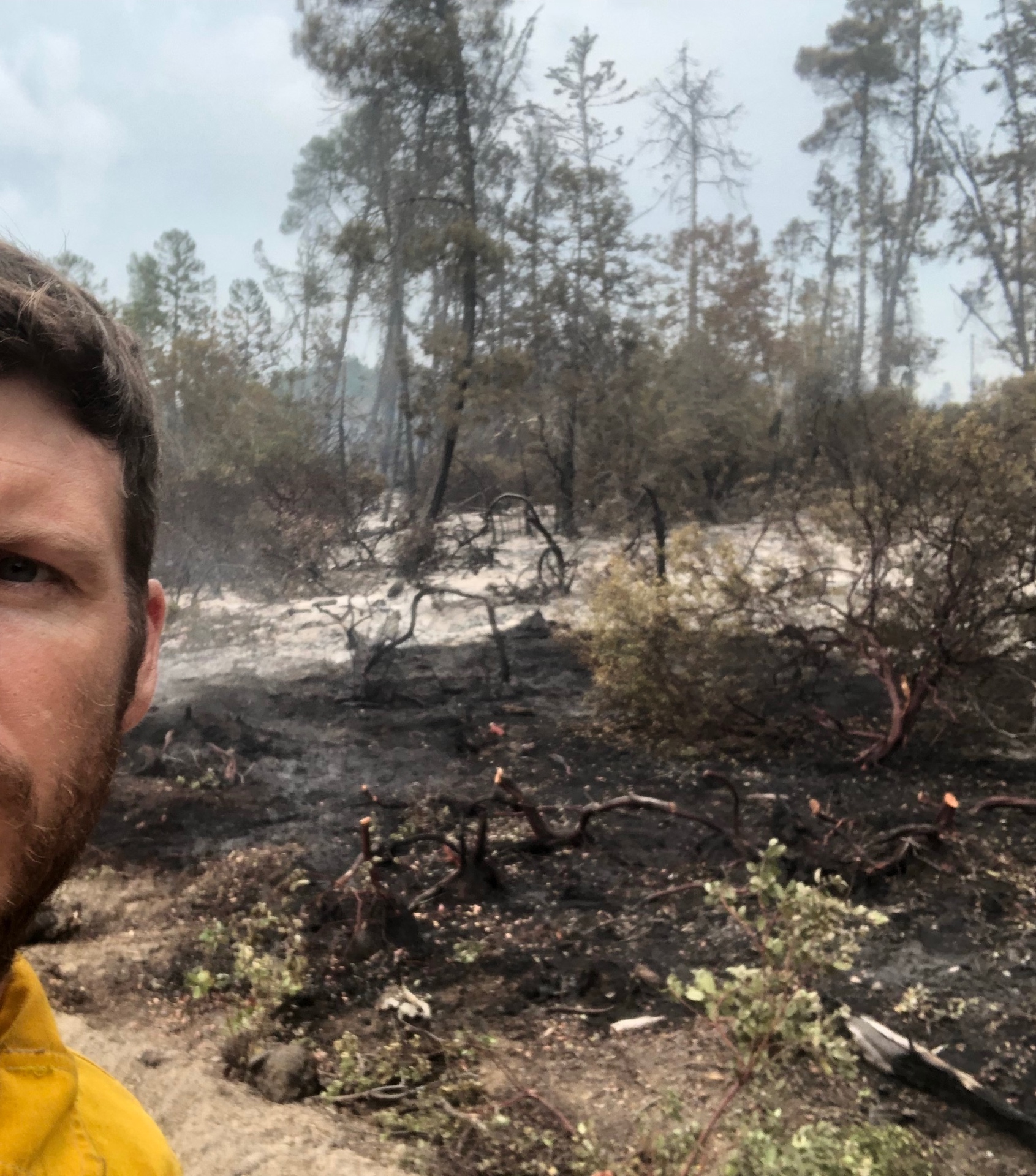
Three years after the CZU Lightning Complex Fire, the hills above Bonny Doon are beginning to recover. But recovery has not unfolded the way many of us expected.
I never imagined that the Type 2 Wildland Firefighter training I completed at Tassajara Zen Mountain Center, while serving as the Parks Natural Resources Program representative for the County of Santa Clara, would one day be called upon in my own community.
The mornings began before breakfast. We gathered quietly, listening to the land and learning from the people around us. Many of those training alongside me were among the first Indigenous representatives in their communities to become Type 2 wildland fire trained. Even then, I sensed that this was something unique, a moment when traditional knowledge, fire ecology, and land stewardship were beginning to come together in new ways.
Over the decade since that training, much has changed. Tribal representation in fire management has grown. The practice of cultural burning and the recognition of “good fire” have become increasingly important parts of ecological restoration and integrated land management throughout California. The lessons I learned working alongside firefighters and natural resource managers in places like Big Sur, where fire is both a threat and an ecological process, became part of my response when flames entered the hills of Bonny Doon.
For those of us who work in natural resource management, fire is something we study, prepare for, and attempt to manage. We develop fuel reduction plans, protect communities, monitor ecosystems, and design restoration strategies. Yet fire has a way of reminding us that landscapes are not machines. They are living systems with histories, adaptations, and their own forms of resilience.
The CZU Lightning Complex Fire forced many of us to reconsider what we mean by restoration. We often approach damaged landscapes with the instinct to repair them quickly, to plant, rebuild, and return things to a version of what existed before. But the land does not always ask for immediate intervention. Sometimes the most important work is observation.
The chaparral and maritime scrub ecosystems surrounding Bonny Doon evolved with fire over thousands of years. Their survival strategies are remarkable. Beneath the soil are seed banks holding generations of ecological memory. Some plants release seeds after exposure to heat. Others resprout from underground structures protected during a burn. Recovery is not always immediately visible, but it is happening.
The native vegetation of the Santa Cruz Mountains tells this story. The hills around Bonny Doon support fire adapted species such as Eastwood’s manzanita (Arctostaphylos glandulosa), Santa Cruz manzanita (Arctostaphylos andersonii), Bonny Doon manzanita (Arctostaphylos silvicola), and other members of the diverse manzanita lineage that help define California chaparral.
The landscape is also home to several species of California lilac, or Ceanothus, including blue blossom (Ceanothus thyrsiflorus), chaparral whitethorn (Ceanothus leucodermis), wavyleaf ceanothus (Ceanothus foliosus), and Monterey ceanothus (Ceanothus rigidus). These plants are not merely survivors of fire. They are participants in an ecological cycle shaped by disturbance.
Among the rarest plants in this region is the Santa Cruz cypress (Cupressus abramsiana, also known as Hesperocyparis abramsiana), a species found only in scattered locations throughout the Santa Cruz Mountains. Like much of California’s fire adapted flora, it carries a relationship with fire that is far more complex than the simple idea of destruction.
Living through CZU changed my understanding of what it means to be a steward of the land. Stewardship is not about controlling every outcome. It is about recognizing our limits.
This is a difficult lesson in a society that values certainty and quick solutions. We want forests to be predictable. We want fires to be preventable. We want recovery to follow a schedule. But ecosystems do not operate on our timelines.
The role of a forester, ecologist, or land manager is not to force nature into compliance with our expectations. It is to understand the processes already underway and make thoughtful decisions that support both ecological health and human safety.
That does not mean abandoning management. Communities living in fire prone landscapes need defensible space, responsible planning, fuels management, and investment in resilient infrastructure. But it does mean approaching restoration with humility.
A forester owes fire respect because fire is part of the landscape. A forester owes the land patience because recovery cannot always be measured in seasons or budgets. And a forester owes communities honesty because living among forests and chaparral means accepting that uncertainty is part of the relationship.
Three years after CZU, the hills of Bonny Doon are teaching us something important: recovery is not always a project we complete. Sometimes it is a process we accompany.
The land is writing its next chapter through seeds, roots, rain, and time.
Our responsibility is not to recreate the landscape we lost.
It is to listen closely enough to understand the landscape that is returning.