Tussock Moths: Begin With Observation
When a 200-year-old Valley oak is covered in tussock moth caterpillars, the first question is rarely how to stop them. It is when the last outbreak was. A forester's case for reading the cycle before reaching for the spray.
Kyle D. Peczkowski
Board Certified Master Arborist & Urban Forester
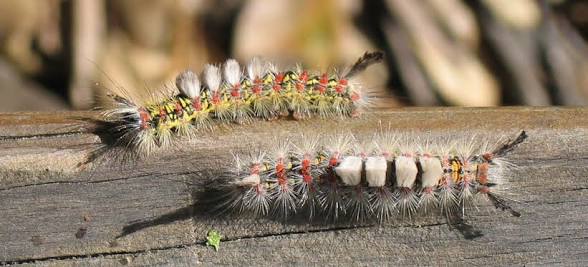
Now, I've written about these guys before but it's come up again. Why such alarm? When people see a tree covered in tussock moth caterpillars, the first reaction is often alarm. The assumption is that the tree is under attack and immediate intervention is necessary. While that response is understandable, it often overlooks the broader ecological story.
Recently, I received a call about a nearly 200-year-old Valley oak adjacent to a Santa Clara County municipal building. The canopy and trunk were covered with tussock moth caterpillars, and concerns quickly turned to whether they would defoliate and ultimately kill the tree.
Before considering management options, I looked through my records. My first question wasn't How do we stop them? It was When was the last outbreak?
Tussock moth populations, like those of many native insects, are cyclical. Similar to cicadas or other insects whose populations naturally fluctuate, tussock moth numbers periodically increase before declining on their own. These population booms are a normal ecological process, not necessarily a sign that intervention is required.
Temporary defoliation, while dramatic in appearance, is often something mature, healthy native oaks have evolved to withstand. Trees and insects have coexisted for thousands of years, each influencing the other's evolution. An isolated outbreak rarely tells the whole story.
What it does signal is an abundance of food.
Tussock moth caterpillars are a valuable source of protein for numerous bird species during the breeding season. An increase in caterpillars often translates into higher nesting success and more fledged songbirds. Those birds, in turn, provide ongoing biological control of many insects we consider economically or aesthetically damaging while also contributing to seed dispersal and overall ecosystem resilience.
This is ecology functioning as it was designed to.
Integrated Pest Management (IPM) encourages us to understand these relationships before reaching for a treatment recommendation. Effective IPM is not simply identifying an insect and determining how to eliminate it. It is evaluating whether management is necessary at all, understanding the thresholds for action, and recognizing when natural systems are already regulating a population.
Certainly, there are situations where intervention is warranted, particularly when dealing with invasive or non-native pests capable of causing long-term ecological damage. However, native insects deserve a different level of consideration. They occupy ecological roles that support birds, mammals, beneficial insects, and countless other organisms that make healthy urban forests possible.
Sometimes the best management decision is observation.
Our landscapes already employ an extraordinary workforce of natural predators and parasites. Birds, predatory insects, spiders, and other wildlife respond to these cyclical increases in prey, helping restore balance over time. These organisms are, in many ways, our original and most sustainable pest managers.
The presence of tussock moths may be visually unsettling, but it is also a reminder that healthy ecosystems are dynamic. Not every insect outbreak is a crisis. Often, it is simply another chapter in the natural cycles that have sustained our native landscapes long before we began managing them.
As arborists and land managers, our responsibility is not only to protect trees but also to understand the ecological communities that allow those trees to thrive. Sometimes that means taking action. Just as often, it means recognizing when nature is already doing the work for us.