Tucson: A Case Study for Valley Water and Neighbor-Based Carbon Sequestration Pilot Projects
Tucson shows how a water utility can turn neighborhood-scale green infrastructure into a measurable carbon and flood-resilience program. Santa Clara Valley Water should take note.
Kyle D. Peczkowski
Board Certified Master Arborist & Urban Forester
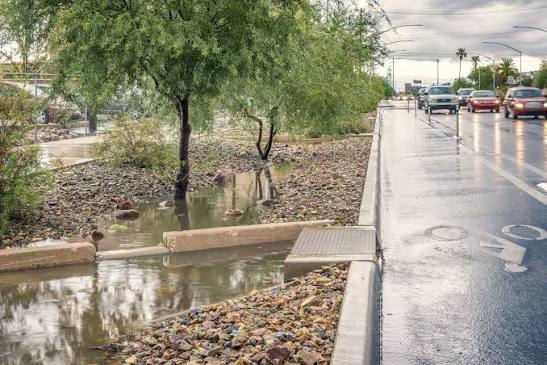
Tucson, Arizona is not the first city that comes to mind when Bay Area water managers look for climate models. It is hotter, drier, and poorer than Santa Clara County. Its water supply is more constrained. Its summers are longer. And yet, in the last decade, Tucson has built something that Valley Water should study closely: a neighborhood-based carbon sequestration and stormwater program that treats green infrastructure as a utility asset.
The model started with a simple observation. In Tucson, most rain does not recharge groundwater. It runs off streets, driveways, and parking lots, picks up pollutants, and floods downstream neighborhoods during summer monsoons. At the same time, the city's urban forest was shrinking from drought, heat, and underinvestment. Trees were dying faster than they were being replaced. The canopy was becoming less equitable, concentrated in older, wealthier neighborhoods while newer developments baked under bare pavement.
Tucson's response was to link water and trees in the same program. Through Green Stormwater Infrastructure rebates, neighborhood-scale rain-harvesting grants, and partnerships with community organizations, the city began retrofitting residential streets and public rights-of-way with curb cuts, bioswales, street-side basins, and native plantings. The goal was not just to slow water down. It was to put water back into the ground where it could support vegetation that stores carbon, shades pavement, and cools neighborhoods.
The carbon piece is what makes the program interesting for Santa Clara County. Every mesquite, palo verde, desert willow, and ironwood planted in a Tucson street basin is doing two jobs at once. It sequesters atmospheric carbon in wood and roots, and it reduces the energy and emissions associated with stormwater management by keeping rainfall local. A tree that survives on harvested rainwater does not need irrigation from a distant reservoir. A basin that infiltrates runoff reduces the size and cost of downstream flood-control infrastructure. The carbon accounting is still being refined, but the direction is clear: green infrastructure can be climate infrastructure.
What makes Tucson a case study rather than a pilot is the neighborhood scale. The city did not wait for a massive capital project. It worked block by block, neighborhood by neighborhood, using community liaisons to identify willing property owners and community groups to maintain early installations. The result is a distributed network of small interventions that, added together, change how an entire watershed behaves. A single curb cut does not matter. A hundred curb cuts in the same watershed changes the hydrograph.
Valley Water is in a position to do something similar, and arguably with more resources. Santa Clara County has more rainfall than Tucson, a larger urban forest, and a water district with a mandate that includes environmental stewardship. The county also has neighborhoods with high heat risk, compacted soils, and limited canopy that would benefit enormously from integrated water-tree interventions. The question is not whether the approach would work here. The question is whether Valley Water and the county's natural resource programs can coordinate closely enough to make it happen.
A Santa Clara County pilot should start with a few focused watersheds. Pick neighborhoods where flooding, heat, and low canopy overlap. Identify streets and rights-of-way where curb cuts, infiltration basins, and native tree plantings could capture and hold stormwater. Partner with residents and community organizations to design and maintain the installations. Measure everything: infiltration rates, tree survival, canopy cover change, summer surface temperatures, and downstream flow reductions.
The carbon accounting should be explicit from the start. Work with a local university or carbon accounting firm to develop a methodology that counts both the carbon stored in vegetation and the avoided emissions from reduced irrigation, reduced pumping, and deferred gray infrastructure. Make the data public. If the pilot works, it becomes a replicable model that other water agencies can adopt. If parts of it fail, the failure is useful too.
There is also an equity dimension that Tucson got right. The neighborhoods that need green infrastructure most are often the neighborhoods with the least political power to demand it. A neighbor-based program has to be designed for participation, not just for aesthetics. That means outreach in multiple languages, compensation for community ambassadors, maintenance support for residents who cannot do the physical work, and transparent site-selection criteria that prioritize need over influence.
The financing model is another lesson. Tucson combined utility rebates, federal stormwater grants, tree-planting funds, and private philanthropy into a single program architecture. That kind of stacking is necessary because no single funding source covers the full value of green infrastructure. Water funds pay for flood control. Climate funds pay for carbon. Health funds pay for heat reduction. A good program design captures all of those benefits and matches them to the right revenue stream.
For county natural resource staff, the Tucson model is a reminder that trees and water are the same system. You cannot manage the urban forest without thinking about where the water comes from. You cannot manage stormwater without thinking about what vegetation is there to absorb it. The silos that separate forestry, flood control, and climate programs in most agencies are administrative conveniences, not ecological realities.
The final lesson is patience. Tucson's program took years to show results. Trees grow slowly in the desert. Soils take time to recover infiltration capacity. Community trust builds one meeting at a time. A pilot in Santa Clara County should be funded for at least five years, with monitoring built in from the start, not as an afterthought.
Valley Water has the opportunity to lead the region on this. The district already manages reservoirs, streams, and floodplains. It already partners with cities on stormwater. What it has not yet done is treat neighborhood green infrastructure as a core water strategy. Tucson proves that it can be done. The next step is a pilot that learns from Tucson's successes, adapts to Santa Clara County's conditions, and builds the case for scaling.
Carbon sequestration does not have to happen only in forests or industrial projects. It can happen on residential streets, in curb cuts, and under native trees watered by rain. The neighbors doing the planting are not just volunteers. They are co-investors in a cooler, more resilient watershed. Tucson figured that out. It is time for the Bay Area to catch up.