Seeding Day: A California Answer to Arbor Day
Arbor Day was written for a different landscape. California's working answer is Seeding Day — hand-collecting seed from existing native perennial grass stands and returning it to county parkland with the sustainability office and the parks range program working the same rope.
Kyle D. Peczkowski
Board Certified Master Arborist & Urban Forester
Arbor Day is a fine holiday, and it was written for a different landscape. The Nebraska prairie in 1872 needed trees because it did not have many. California, by contrast, has plenty of oaks where oaks belong, and the ecosystem doing the actual heavy lifting on our working landscapes is not the canopy — it is the understory. Specifically, it is the native perennial bunchgrass community: purple needlegrass, blue wildrye, California melic, creeping wildrye, and the small forbs that live between them. That community is what holds soil through a January atmospheric river, what carries a low-intensity prescribed fire without crowning, and what feeds the pollinator and ground-nesting bird populations that the county's biodiversity plans are counting on.
So the county's sustainability office and the county parks range program have started running Seeding Day — a spring and early-summer field program in which staff and trained volunteers hand-collect seed from existing native perennial grass stands on county parkland and return that seed, in the same watershed, to adjacent degraded parcels where the annual grass community has taken over. It is Arbor Day's civic energy pointed at the layer of the landscape that most needs it here.
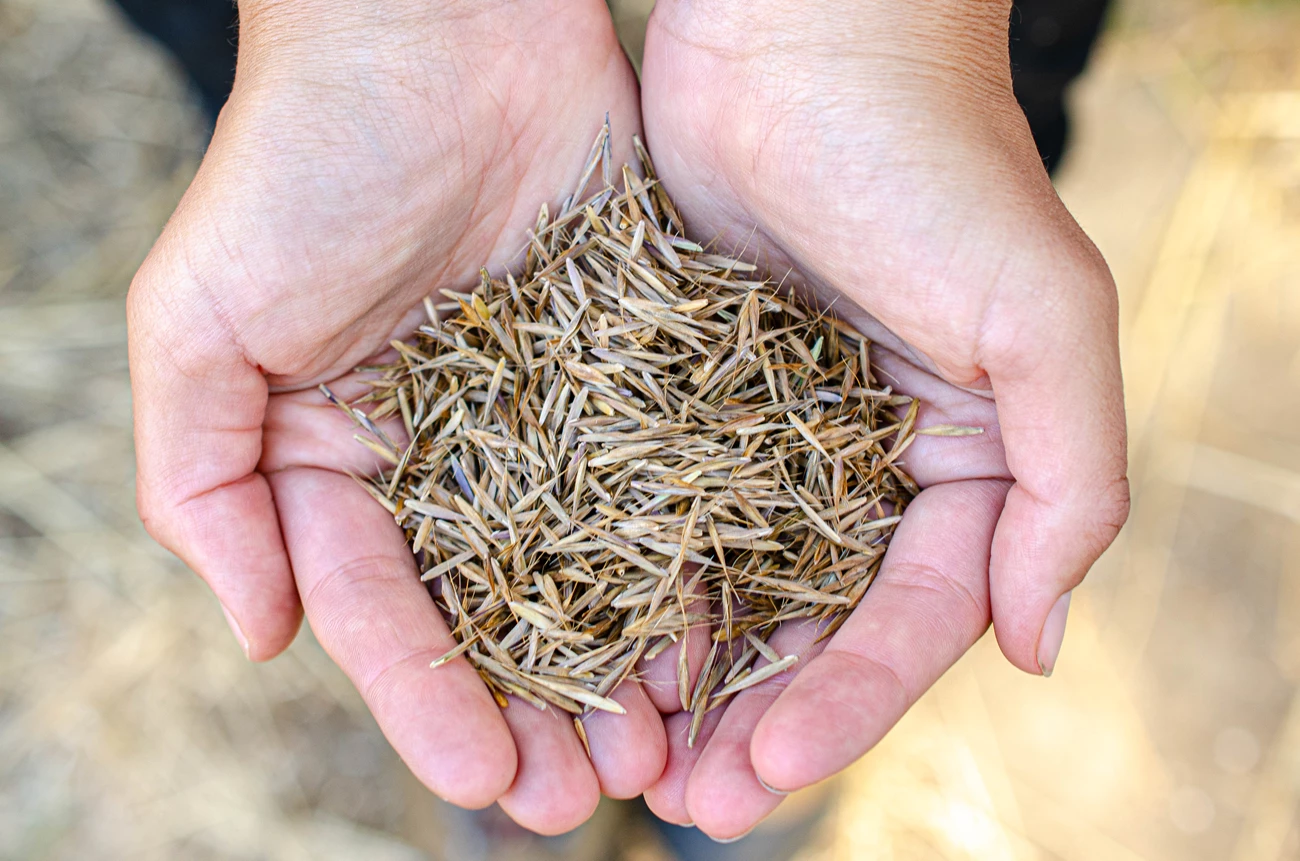
The mechanics matter, because this is the part that gets skipped when the practice is described as 'just scatter some native seed.' Seed is collected by hand from mapped, monitored donor stands — stands that have been surveyed for genetic and species composition, and that can sustain a defined percentage of seed harvest without compromising their own recruitment. Collection windows are narrow: needlegrass a few weeks in late May and early June, wildrye later, melic earlier. Volunteers work in pairs with paper bags, hand strippers, and a data sheet that records donor stand, date, and phenology. The seed is dried on screens in a shed at the parks yard, cleaned lightly, and stored short-term before fall installation.
Installation is not a broadcast-and-hope operation. Seeding Day pairs with a fall field day where the collected seed is drilled or hand-raked into receiver sites that have been prepared through the previous year's grazing pass or a targeted mow — the annual grass thatch layer opened up so the native seed can reach mineral soil. This is where the grazing program and the seed program stop being two separate line items and start being one integrated practice: the cattle open the seedbed, the volunteers close it.
The sustainability office's role in this is not ornamental. Sustainability owns the volunteer coordination, the data platform where donor and receiver stands are tracked over time, the reporting that ties the practice to the county's biodiversity and climate resilience commitments, and the schools and community outreach that turns Seeding Day into a public event rather than an internal work day. Parks owns the land, the range staff, the equipment, and the ecological prescription. Neither program could run the practice alone. The fact that both are county departments — rather than the more common pattern of one being an outside nonprofit chasing a grant — is what makes the program continuous year over year rather than episodic.
The receiver sites are chosen deliberately. Priorities in order: former grazing paddocks that have slid toward medusahead or ripgut brome dominance and need help to shift back; post-fire scars where the seedbank did not recover on its own; road decommissioning corridors where restoration is written into the closure plan; and small demonstration plots on high-visitation parkland where the interpretive value of a healthy native sward — for visitors, for school groups, for the county's own staff — is worth the extra investment.
The metric that matters at year three is not seedling count in year one. It is percent perennial cover, species richness, and — the honest one — annual grass thatch depth going into fire season. On the parcels where Seeding Day has now run for three cycles paired with rotational grazing, thatch depth at June 1 is down measurably, native perennial cover is up in the 15 to 30 percent range from a starting condition often below 5 percent, and the fire program can put a prescribed burn on the ground with a straight face.
The framing question is what to call it publicly. 'Native grass restoration' is accurate and unmemorable. 'Seeding Day' borrows the civic muscle memory of Arbor Day and points it at the layer of the California landscape that most needs the volunteer hour and the school-group visit. It gives the sustainability office a public-facing event that ties directly to a working parks program, and it gives the parks range crew a pipeline of trained volunteers who understand why the cattle were on the parcel in April and why the seed went in the ground in October.
Arbor Day is not wrong. It is just not the whole California answer. The whole answer includes the day the county goes out to the hillside with paper bags and comes back with next year's grassland in the trunk of a parks truck.