Santa Clara County Was a Food Forest of Orchards. Why Stop Now?
For more than a century, Santa Clara County was an orchard landscape — prunes, apricots, cherries, walnuts. Planting food trees today is not nostalgia; it is a practical strategy for culture, climate resilience, and regional food security.
Kyle D. Peczkowski
Board Certified Master Arborist & Urban Forester
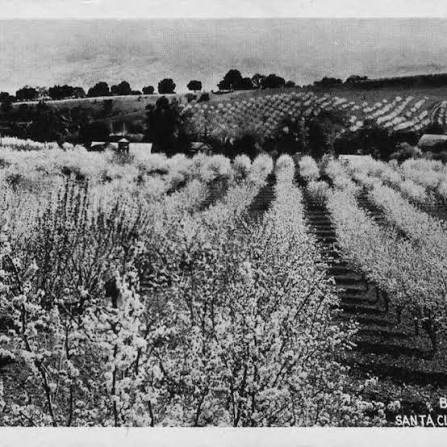
Before it was Silicon Valley, Santa Clara County was the Valley of Heart's Delight — a quilt of orchards and row crops that made the region one of the most productive agricultural landscapes in the country. Prune orchards ran for miles along the bayshore. Apricot and cherry trees flowered pink and white on the valley floor. Walnut groves and citrus hedgerows marked property lines and fed families. The fruit was not a novelty; it was the economy, the culture, and the working identity of the place.
That landscape is mostly gone now, paved for subdivisions, research parks, and freeways. But the underlying conditions that made it productive have not changed. The soil is still deep and fertile. The Mediterranean climate — wet winters, dry summers, long growing season — is still ideal for a wide range of fruit and nut trees. The water infrastructure, for all its stresses, still moves supply across the county. What changed was the land-use decision, not the land's capacity.
The argument for planting food trees again is not a sentimental one. It is a resiliency argument, and it lands in three places at once.
First, food trees are climate infrastructure. A mature deciduous fruit tree shades pavement, transpires water, and drops the local ambient temperature by several degrees in summer. That cooling happens exactly when heat waves are most dangerous. Unlike shade structures, the tree also filters air, absorbs stormwater, and sequesters carbon while it works. The co-benefit list is the reason urban foresters already defend street trees; food trees simply add harvest to the ledger.
Second, food trees are food security infrastructure. The county's food system is long, fragile, and heavily dependent on trucking produce from the Central Valley, Mexico, and beyond. A localized layer of public and institutional fruit trees does not replace commercial agriculture, but it does diversify the supply. In a disruption — a drought, a fire season that closes highways, a public health emergency — a neighborhood with mature figs, persimmons, and citrus is a neighborhood with options.
Third, food trees are cultural infrastructure. For the county's many immigrant communities, specific fruit trees carry memory: loquat, jujube, pomegranate, olive, sapote, mango in sheltered microclimates. Planting these trees in public space is a way of saying that the county's agricultural identity is not only historical but ongoing, and that the people living here now get to shape what grows. It turns parks and schoolyards into living classrooms and living pantries at the same time.
The practical question is where, and how, to do this responsibly. Not every street tree should be a fruit tree. A dripping persimmon over a sidewalk in October is a hazard and a maintenance headache. But there are plenty of places where food trees fit cleanly into the public landscape: the interior of parks, where maintenance crews can manage drop; school campuses, where fruit becomes part of nutrition and garden curriculum; community orchards on county-owned surplus parcels; and the back side of parking lots and civic buildings, where shade and harvest can coexist without conflict.
Species selection matters. The county's best candidates are drought-tolerant, pest-resistant, and suited to the local soils: fig, pomegranate, olive, persimmon, citrus in the warmer microclimates, and selected stone fruits where fire blight and brown rot can be managed. Native food plants — toyon, elderberry, California rose, oak — should be part of the mix too, supporting wildlife while they produce. The goal is not a monoculture commercial orchard. It is a polyculture of useful, resilient trees that fits the site.
The objections are familiar, and they are not wrong. Fruit drop is messy. Wasps and rodents show up. Some people worry about liability if a child climbs a tree. These are management questions, not reasons to avoid the practice. Managed orchards use ground cover beneath the canopy to absorb drop, scheduled harvests to remove fruit before it ferments, and signage that teaches rather than forbids. Liability for public fruit trees is well understood and no more complex than liability for any other public tree; the risk lives in poor maintenance, not in the species.
There is also a workforce opportunity. The county's urban forestry and parks crews already prune, inspect, and manage trees. Adding food-tree care to that skill set — training in fruit-tree pruning, harvest timing, and pest monitoring — creates career pathways and reconnects public land management to food production. Partnering with community groups, master gardeners, and school districts spreads the labor and builds ownership.
The deeper point is that a county serious about climate resilience, biodiversity, and equitable access to green space should be serious about productive landscapes. A tree that only provides shade is a fine tree. A tree that provides shade, cooling, habitat, carbon storage, and food is a better tree — and Santa Clara County has already proven, across a hundred and fifty years of orchards, that it knows how to grow them.
The question is not whether we can return to an orchard economy. We cannot, and probably should not. The question is whether we are wise enough to remember that the county's trees were once its wealth, and to plant the next generation of food-bearing trees where they can serve the people who live here now. The answer, in parks and schoolyards and public parcels across the county, should be yes.