Reading a Stump: The Stories Written in Wood
From the perspective of a Natural Resources Program Supervisor: a cross-section of a stump is a biological journal written in wood, recording drought, abundance, fire, and resilience across a lifetime.
Kyle D. Peczkowski
Board Certified Master Arborist & Urban Forester
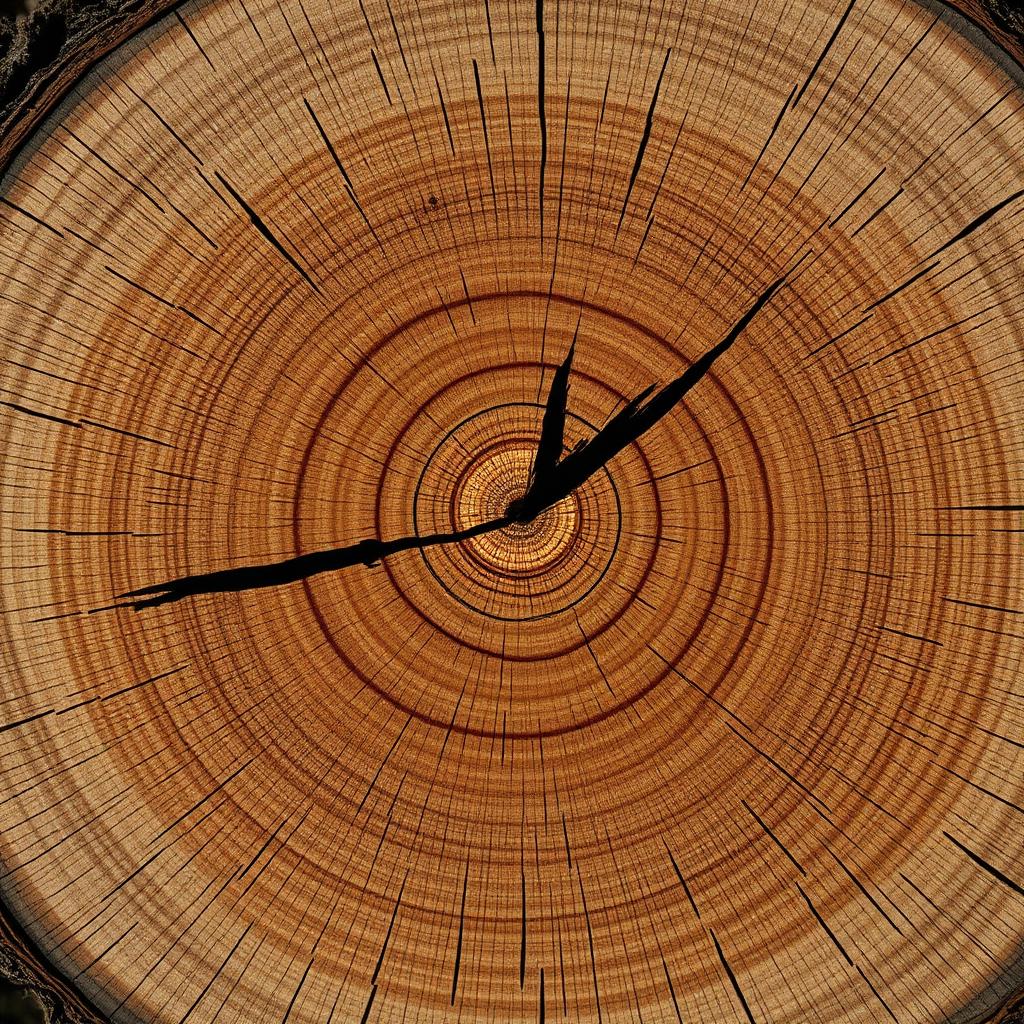
Growing up in Indiana, I spent countless hours tromping through the woods along the Saint Joseph River watershed. Those forests were my classroom long before I understood the science behind them. I wandered among sassafras, pine, cherry, and oak, discovering the quiet stories left behind by fallen giants brought down by winter storms and blizzards.
Whenever I encountered a fallen log, my hand was naturally drawn to the trunk. I would place my palm against the wood, feeling its coolness and the texture of the bark that had once protected a living organism reaching toward the sky. There was something humbling about touching a tree that had endured decades, sometimes centuries, of changing seasons.
If I was fortunate, a farmer or property owner had sawn through the diameter of the trunk, revealing the hidden architecture inside. The exposed cross section displayed an intricate spiral of lines and patterns. At first glance, it could resemble a spider web, a vortex, or some mysterious map leading inward toward the soul of the tree. But what appeared to be simple rings were actually a detailed record of the tree's entire life, a biological journal written in wood.
Within those rings were the winters survived, the droughts endured, the wet years of abundance, the fires avoided, the insects battled, and the countless days when the tree provided shelter and nourishment for birds, mammals, insects, and the forest community around it.
Now, as a Natural Resources Program Supervisor, I see those patterns differently. The stump is no longer just a remnant of a fallen tree. It is a scientific record. It is a timeline. It is a story waiting to be read.
The Living Architecture Beneath the Bark
To understand growth rings, we first have to understand the tissues that create them.
A tree grows outward from a thin layer of living cells called the vascular cambium. This layer sits between the inner wood, known as xylem, and the outer living tissues of the tree. Each year, the cambium produces new cells that expand the tree's diameter.
The tree's tissues each have a purpose.
The bark is the protective outer covering. It shields the tree from insects, disease, weather, and physical damage.
The phloem is the living transport tissue just beneath the bark. It moves sugars produced during photosynthesis from the leaves to the rest of the tree.
The vascular cambium is the growth engine. This thin layer creates new wood and new phloem every growing season.
The xylem becomes the wood we see in a stump. It transports water and minerals upward from the roots and provides structural support.
Each year, the cambium lays down a new layer of xylem. These layers accumulate, creating the growth rings that allow us to look backward through the life of the tree.
The Beauty of an Annual Ring
A growth ring is not simply a line. It is a record of changing conditions throughout a growing season.
In temperate forests like those of the Midwest, trees experience a yearly cycle. During spring, when water is plentiful and temperatures rise, the tree produces earlywood. These cells are larger, thinner walled, and designed to move water quickly. Earlywood appears lighter in color and forms the wider portion of the annual ring.
As summer progresses and growth slows, the tree produces latewood. These cells are smaller, thicker walled, and stronger. Latewood appears darker and creates the boundary between one year's growth and the next.
Together, the light earlywood and dark latewood form one annual growth ring.
A tree's rings are like fingerprints, unique to that individual. No two trees experience exactly the same combination of weather, soil conditions, competition, injury, and environmental pressures.
The beauty of a growth ring is not only found in its appearance. It is found in the story it carries. Each circle represents a season of survival, adaptation, and growth. The tree has recorded its relationship with the environment around it, creating a pattern that is both scientifically valuable and visually breathtaking.
The Science of Reading Growth Rings
The scientific study of tree rings is called dendrochronology. The word comes from Greek roots meaning tree, time, and study. Scientists use tree rings to understand not only the age of a tree but also the history of the environment around it.
A wide growth ring often indicates favorable conditions such as adequate rainfall, healthy soil moisture, plenty of sunlight, limited competition, and a long growing season.
A narrow growth ring can tell a different story. It may indicate drought, extreme temperatures, insect outbreaks, disease, competition from surrounding trees, or physical damage.
The tree silently records these events. A drought does not leave a newspaper article behind, but it leaves a narrow ring. A year of abundant rainfall does not leave a written report, but it leaves a wider band of growth.
Scientists can compare ring patterns from many trees to reconstruct past climates and ecological events. Ancient trees have helped researchers understand historic droughts, wildfire cycles, floods, and changes in forest health.
A tree can become an environmental historian. Its rings provide evidence of how landscapes have changed over time and how forests respond to pressure and recovery.
More Than Age: A Tree's Life Story
When we count rings, we learn a tree's age, but that is only the beginning.
A growth ring can reveal when a tree was damaged. A scar inside the wood may show where fire, lightning, insects, or animals affected the tree. A sudden change in ring width may indicate when a forest was cleared nearby, allowing more sunlight to reach the tree. A shift in growth patterns can show changes in competition or climate.
The tree is telling us:
"This is when I struggled. This is when I flourished. This is when the world around me changed."
The stump becomes a landscape archive.
It tells us about the water available each year. It tells us about the seasons the tree endured. It tells us about the relationship between climate, soil, wildlife, and human decisions. The tree does not speak with words, but it communicates through patterns that have been forming for generations.
A Connection Between Generations
I think back to that boy riding dirt bikes through the forest trails, finding shaded avenues beneath the Midwest canopy. Those woods were not just a place to travel through. They were places of discovery, imagination, and connection.
The trees provided cool shade on hot summer days. They created habitat for birds and flying squirrels. They held soil in place, filtered water, stored carbon, and shaped the character of the watershed.
Even after a tree falls, it continues teaching.
A cross section of a stump gives us a rare gift: the ability to look directly into the life of another organism. It allows us to count the seasons it experienced and imagine the storms it survived. It reminds us that forests are not collections of objects. They are communities of living beings with histories.
Every ring represents a year that the tree stood watch over the land.
Every ring is a memory.
Every ring is a lesson.
And when we place our hand on that wood, we are not simply touching a tree.
We are touching time.
From the Woods of Indiana to a Life of Service
When I think back to that young boy growing up in Indiana, walking the woods along the Saint Joseph River watershed, I never could have imagined where those moments of curiosity would lead.
That boy who placed his hand on fallen logs, who studied the patterns carved into oak, cherry, pine, and sassafras, and who found adventure riding dirt bikes through forest trails could never have dreamed that one day he would dedicate his life to protecting natural resources and helping others discover the same connection to the land.
The forests of my childhood planted a seed. They taught me that every tree has a story, every watershed has a history, and every landscape holds lessons waiting to be uncovered. What began as simple wonder became a lifelong commitment to understanding and caring for the natural world.
Today, as a public servant with the County of Santa Clara working as a Natural Resources Program Supervisor, I have the privilege of helping communities connect with nature, protect the resources that sustain us, and recognize the value of the ecosystems around us.
The same sense of awe I felt as a child standing beside a fallen tree continues to guide my work today. Whether it is a valley oak standing along a California landscape or a hardwood log resting on the forest floor in Indiana, the message remains the same. Nature is constantly communicating with us if we are willing to listen.
A tree's rings tell us about drought and abundance, storms and recovery, challenges and resilience. They remind us that time leaves a mark on everything, and that our responsibility is not only to study these stories but to protect the forests, watersheds, and natural communities that will create stories for generations to come.
That little boy in Indiana never could have dreamed that his curiosity among the trees would become a calling. He never could have imagined that touching the cool surface of a fallen trunk would lead to a career serving others and protecting the natural world.
But perhaps the trees knew all along.
They were teaching him how to listen.