Raptor Fest in the Old Snag: Why This Forester Says Leave the Dead Trees. It's IPM!
A dead oak snag is not a hazard waiting to happen. It is a hunting platform, a nest site, and a pest-control service. Leaving standing dead wood is one of the most effective IPM decisions a land manager can make.
Kyle D. Peczkowski
Board Certified Master Arborist & Urban Forester
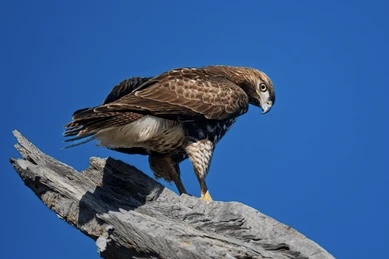
Walk into any mature oak woodland in Santa Clara County and you will find them: the dead trees. Not the ones that lean over a trail or threaten a roofline, but the standing snags — the ones with stripped bark, hollow tops, and branches that end in splintered points. To a certain kind of eye, they look like failure. To a forester, they look like infrastructure. And to the hawks, owls, and falcons that use them, they look like lunch.
I call it raptor fest. On a good snag in the right place, you can watch a red-tailed hawk launch a morning hunt, a Cooper's hawk slip through the canopy after songbirds, and a great horned owl settle in at dusk. The snag is not just a perch. It is a hunting blind with a three-hundred-and-sixty-degree view of the ground where rodents move. Raptors are visual hunters. They need elevation, open sightlines, and a stable platform. A dead tree with a broken top delivers all three better than most live trees ever will.
This is where Integrated Pest Management comes in. IPM is not a chemical checklist. It is a decision framework that asks: what is the least disruptive way to keep a pest population below a damaging threshold? In oak woodlands, grasslands, and park edges, the pests we most often worry about are rodents — ground squirrels, voles, gophers — and the insects that follow them. Poison baits work, sort of, until they stop working and start killing the non-target animals that eat the poisoned prey. Trapping works, but it is labor-intensive and never scales to landscape-level management.
Raptors scale. A single red-tailed hawk can consume hundreds of rodents in a season. A pair of barn owls with a nest full of chicks can take a thousand or more. They do not need a contract, a truck, or a safety data sheet. They need habitat. And habitat, in this case, means leaving the dead trees standing.
The ecological value of a snag does not stop with raptors. Cavity-nesting birds — woodpeckers, bluebirds, titmice, nuthatches — excavate or occupy holes in the softened heartwood. Those same cavities become dormitories for bats, refuges for insects, and eventually seed traps where soil accumulates and new plants take hold. A standing dead tree is a vertical decomposition engine, moving carbon and nutrients back into the system while it still provides structure.
Of course, not every dead tree should stay. A snag in a high-use picnic area, within falling distance of a trail, or directly above a parking lot is a liability. Those trees come down, or they are reduced to a safe height. But the vast majority of dead trees in our parks and open space lands are nowhere near a target. They are in the back corners of preserves, along fencelines, in oak savannas where the only people who pass are deer and coyotes. Those are the ones we should leave.
The hesitation is cultural. We have trained ourselves and the public to see dead wood as messy, dangerous, or diseased. Landscapes are supposed to be green and leafy; brown and bare feels like neglect. But a healthy ecosystem is not a manicured one. Dead wood is as essential to woodland function as live leaves. The question is not whether a landscape has snags — every landscape that ever supported an oak woodland had them. The question is whether we are wise enough to let them stay.
In the county's natural resource program, we are starting to write snag retention into our management plans. The language is simple: retain all standing dead trees outside the fall radius of occupied structures, trails, and roads unless they present an imminent hazard. Where natural snags are scarce, we install artificial raptor perches or create wildlife trees by topping selected hazard trees rather than removing them entirely. The goal is not to leave every tree; it is to maintain a threshold density of dead and dying structure across the landscape.
The results show up quickly. In preserves where snag retention has been formalized, we see higher raptor activity, reduced rodent damage to restoration plantings, and fewer requests for chemical control. The birds do the work. The public gets to see hawks and owls. The budget gets a break. It is the rare management decision where ecology, economics, and public enjoyment all move in the same direction.
There is a bigger idea here, too. IPM asks us to think in systems, not products. A pest problem is rarely solved by the thing you spray. It is solved by the conditions that let natural enemies do their job. In a landscape, those conditions include diverse vegetation, undisturbed soil, connected habitat, and yes, dead wood. Remove the snags and you remove the raptors. Remove the raptors and the rodents multiply. Multiply the rodents and someone demands poison. The poison works for a season, then the cycle gets worse. The alternative is to keep the snag.
Next time you see a dead tree in a park, try looking at it the way a hawk does. It is not a failure of maintenance. It is a perch, a pantry, and a pest-management station rolled into one. Leave it standing, and you are not being lazy. You are being a forester.