Measuring the Canopy That Matters
A functional framework for evaluating urban forest performance, community benefits, and long-term resilience. Percent canopy cover is a start, but it is not the final measure of success.
Kyle D. Peczkowski
Board Certified Master Arborist & Urban Forester
As a Board Certified Master Arborist and urban forester, I have spent my career evaluating not only the condition of trees, but also the measurable benefits they provide to the communities they serve. Through my work in Santa Clara County, I have become increasingly focused on a fundamental question: Are we measuring urban forests in a way that reflects the services they provide?
Percent canopy cover has become one of the most common metrics used to evaluate urban forests. It is understandable why this metric is widely used. It is relatively simple to calculate, easy to communicate, and useful for tracking broad changes in urban forest extent over time. However, canopy percentage alone provides only a partial understanding of urban forest performance.
A canopy measurement tells us how much tree cover exists when viewed from above. It does not fully describe whether that canopy is cooling neighborhoods, improving air quality, reducing stormwater runoff, storing carbon, supporting biodiversity, improving human health, or providing benefits where communities need them most.
Through my work in Santa Clara County, I developed The Canopy That Matters Framework, a functional approach for evaluating urban forests as living infrastructure. This framework integrates ecological performance, public health benefits, economic value, and mature tree preservation to provide a more complete understanding of the role trees play in creating resilient communities. The objective is not simply to measure how much canopy exists. The objective is to measure how effectively that canopy performs.
The Limitations of Percent Canopy Cover
Canopy cover remains a valuable planning metric, but it does not distinguish between canopy that is highly functional and canopy that provides limited community benefit.
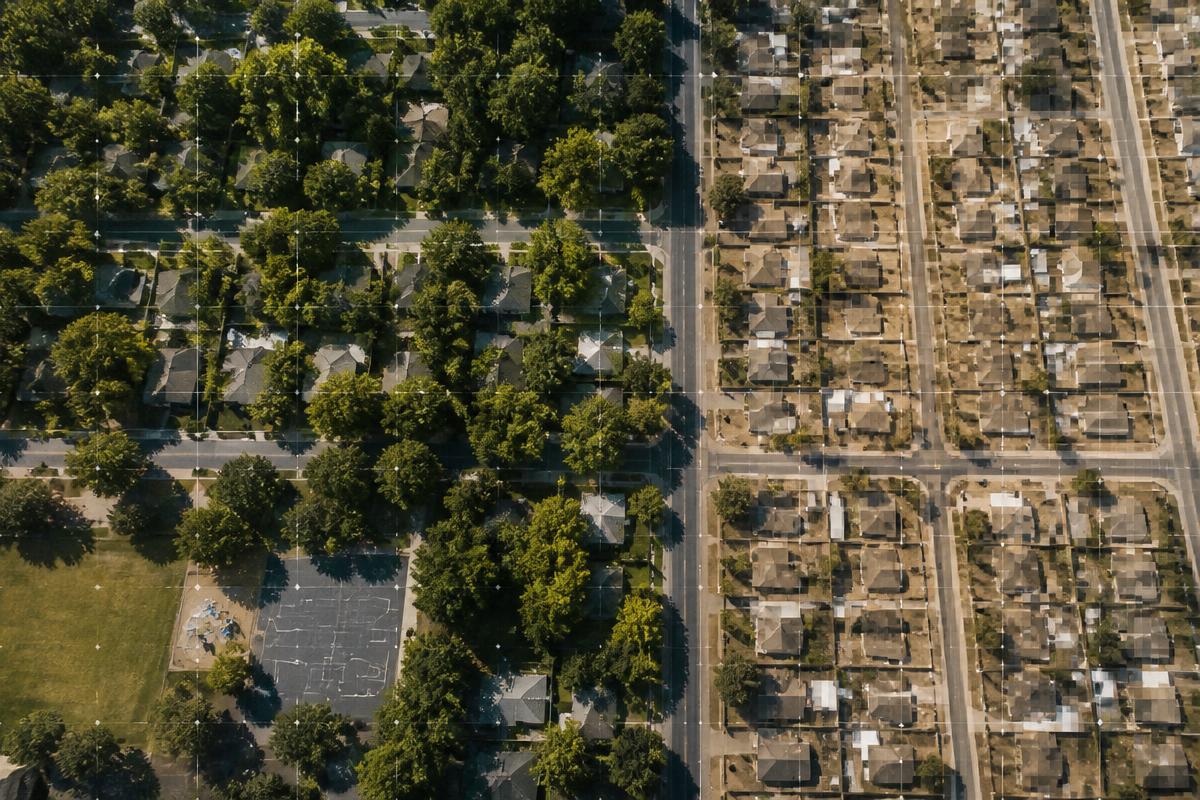
Two neighborhoods may each report 25 percent canopy cover while producing very different environmental outcomes. One neighborhood may contain large, healthy, mature trees shading homes, schools, sidewalks, and public spaces. Another may contain a similar amount of canopy concentrated over undeveloped land, isolated parcels, or areas where residents receive fewer direct benefits.
Canopy percentage does not account for tree health, structural condition, species diversity, age distribution, drought tolerance, or expected longevity. It also does not identify whether trees are located where heat exposure, air pollution, flooding, and public health concerns are greatest.
For these reasons, canopy cover should be considered a measurement of extent, not a complete measurement of urban forest performance.
The Canopy That Matters Framework
The Canopy That Matters Framework evaluates urban forests through multiple layers of performance. The framework asks five fundamental questions: What exists? What does it do? Who benefits? What value does it provide? What existing assets must be protected?
Layer 1: Canopy Inventory and Baseline Conditions
The first layer establishes the physical condition of the urban forest. Measurements include canopy extent, tree population, species composition, age distribution, tree condition, and geographic distribution. This inventory provides the foundation for understanding existing resources but does not determine performance by itself.
Layer 2: Functional Canopy Performance Index
The Functional Canopy Performance Index evaluates the services produced by urban forests. The index includes seven performance categories.
Urban Cooling Performance. Trees reduce urban heat through shade and evapotranspiration while reducing building energy demand. The cooling score evaluates canopy location within heat-vulnerable areas, shade provided to pedestrians, building shade potential, and canopy maturity and density. A strategically located tree canopy can provide greater cooling benefits than a larger amount of canopy located where people experience limited exposure to its benefits.
Air Quality Improvement. Trees improve air quality by removing particulate matter, ozone, nitrogen dioxide, and other pollutants through deposition and uptake by foliage. The air quality score evaluates proximity to pollution sources, leaf area and canopy density, species characteristics, and tree health.
Stormwater Management. Urban trees function as distributed green infrastructure. Leaves intercept rainfall, branches slow precipitation, and root systems improve infiltration. The stormwater score evaluates rainfall interception, root zone function, impervious surface reduction, and avoided runoff. Calculations may incorporate the U.S. Forest Service i-Tree Eco model.
Carbon Storage and Climate Benefits. Urban forests provide both immediate and long-term climate benefits. Large mature trees represent decades of accumulated carbon storage and ecological investment. While young trees provide future benefits, they cannot immediately replace the services provided by established trees. The carbon score evaluates existing carbon storage, annual sequestration, future growth potential, and climate adaptability.
Urban Forest Resilience. A successful urban forest must persist over time. The resilience score evaluates species diversity, age distribution, tree condition, pest and disease resistance, and climate adaptability. A diverse urban forest is better positioned to withstand drought, invasive pests, and changing environmental conditions.
Environmental Equity. Urban forest benefits are not distributed equally. Neighborhoods with lower canopy often experience higher temperatures, poorer air quality, and increased exposure to environmental stressors. The equity score evaluates heat vulnerability, canopy deficits, public health needs, and access to green space. This approach aligns with emerging urban forestry equity frameworks, including American Forests' Tree Equity Score methodology.
Human Health and Wellbeing. Trees influence human health through multiple pathways, including heat reduction, improved air quality, increased physical activity, and psychological restoration. The health and wellbeing score evaluates potential reduction in heat-related illness, respiratory health benefits, healthcare utilization trends, behavioral health benefits, and access to restorative green space. The inclusion of human health recognizes that urban forests are not only ecological assets but also public health infrastructure.
Layer 3: Mature Tree Preservation Layer
A mature tree is not simply a larger version of a young tree. It represents decades of accumulated biological function. The Mature Tree Preservation Layer recognizes the unique value of established trees and evaluates what is lost when mature canopy is removed.
The preservation score evaluates canopy size and leaf area, carbon storage, cooling contribution, stormwater function, habitat value, and remaining service life. This layer addresses a critical management question: What ecosystem services are lost when an established tree is removed, and how long will replacement take? Preserving mature trees protects existing environmental assets that cannot be immediately replicated through new planting.
Layer 4: Economic Conversion Layer
Translating ecosystem services into public value helps urban forestry investments be better understood. The Economic Conversion Layer evaluates public health value, including avoided healthcare costs, reduced heat-related illness, reduced respiratory impacts, and behavioral health benefits. It evaluates energy value, including reduced cooling demand, building energy savings, and urban heat reduction benefits. It evaluates stormwater value, including reduced runoff, reduced stormwater infrastructure demand, and watershed protection benefits. It evaluates carbon value, including existing carbon storage, annual sequestration, and climate benefits. And it evaluates community value, including improved neighborhood conditions, access to green space, and community quality of life benefits. The purpose of this layer is to communicate urban forest benefits in the same economic language used for other public infrastructure investments.
Layer 5: Decision Support and Investment Prioritization
The final layer translates assessment results into management decisions. The framework identifies opportunities where investments can produce the greatest return, including heat-vulnerable neighborhoods, areas with canopy deficits, locations with public health concerns, high-value mature tree preservation opportunities, and projects producing the greatest ecosystem service return. This allows communities to move from simply counting trees to strategically managing urban forest performance.
Conclusion
Percent canopy cover remains an important measurement tool, but it should not be the final measure of urban forest success. The future of urban forestry requires a more complete understanding of trees as living infrastructure. Urban forests provide measurable benefits that extend beyond appearance. They cool neighborhoods, improve air quality, manage stormwater, store carbon, support biodiversity, strengthen community health, and contribute economic value.
The Canopy That Matters Framework provides a method for evaluating these benefits in a comprehensive and practical way. The most successful urban forests will not simply be those with the highest canopy percentages. They will be the forests that perform the greatest number of essential functions, reach the communities that need them most, and remain healthy enough to provide benefits for generations. The canopy that matters is the canopy that works.
References
American Forests. (2021). Tree Equity Score Methodology. Gilman, E. F. (2012). An Illustrated Guide to Pruning (3rd ed.). Delmar. Konijnendijk, C. C. (2023). The 3–30–300 Rule for Urban Forestry and Greener Cities. Urban Forestry & Urban Greening. Livesley, S. J., McPherson, E. G., & Calfapietra, C. (2016). The urban forest and ecosystem services: Impacts on urban water, heat, and pollution cycles at the tree, street, and city scale. Journal of Environmental Quality, 45(1), 119–124. McPherson, E. G., van Doorn, N., & de Goede, J. (2016). Structure, function and value of street trees in California, USA. Urban Forestry & Urban Greening, 17, 104–115. Nowak, D. J., & Dwyer, J. F. (2007). Understanding the Benefits and Costs of Urban Forest Ecosystems. In J. E. Kuser (Ed.), Urban and Community Forestry in the Northeast (2nd ed.). Springer. Nowak, D. J., Hirabayashi, S., Bodine, A., & Greenfield, E. (2014). Tree and forest effects on air quality and human health in the United States. Environmental Pollution, 193, 119–129. Smiley, E. T., Matheny, N., & Lilly, S. Best Management Practices: Tree Risk Assessment. International Society of Arboriculture. United States Environmental Protection Agency. Reducing Urban Heat Islands: Compendium of Strategies. United States Forest Service. i-Tree Eco User's Manual. Xiao, Q., McPherson, E. G., Ustin, S. L., Grismer, M. E., & Simpson, J. R. (2000). Winter rainfall interception by two mature open-grown trees in Davis, California. Hydrological Processes, 14(4), 763–784.