Field Notes: A Season with Heritage Oaks
Reflections from two years of Level 2 risk assessments on twelve hundred heritage valley oaks, and what the oldest trees keep trying to tell us.
Kyle D. Peczkowski
Board Certified Master Arborist & Urban Forester
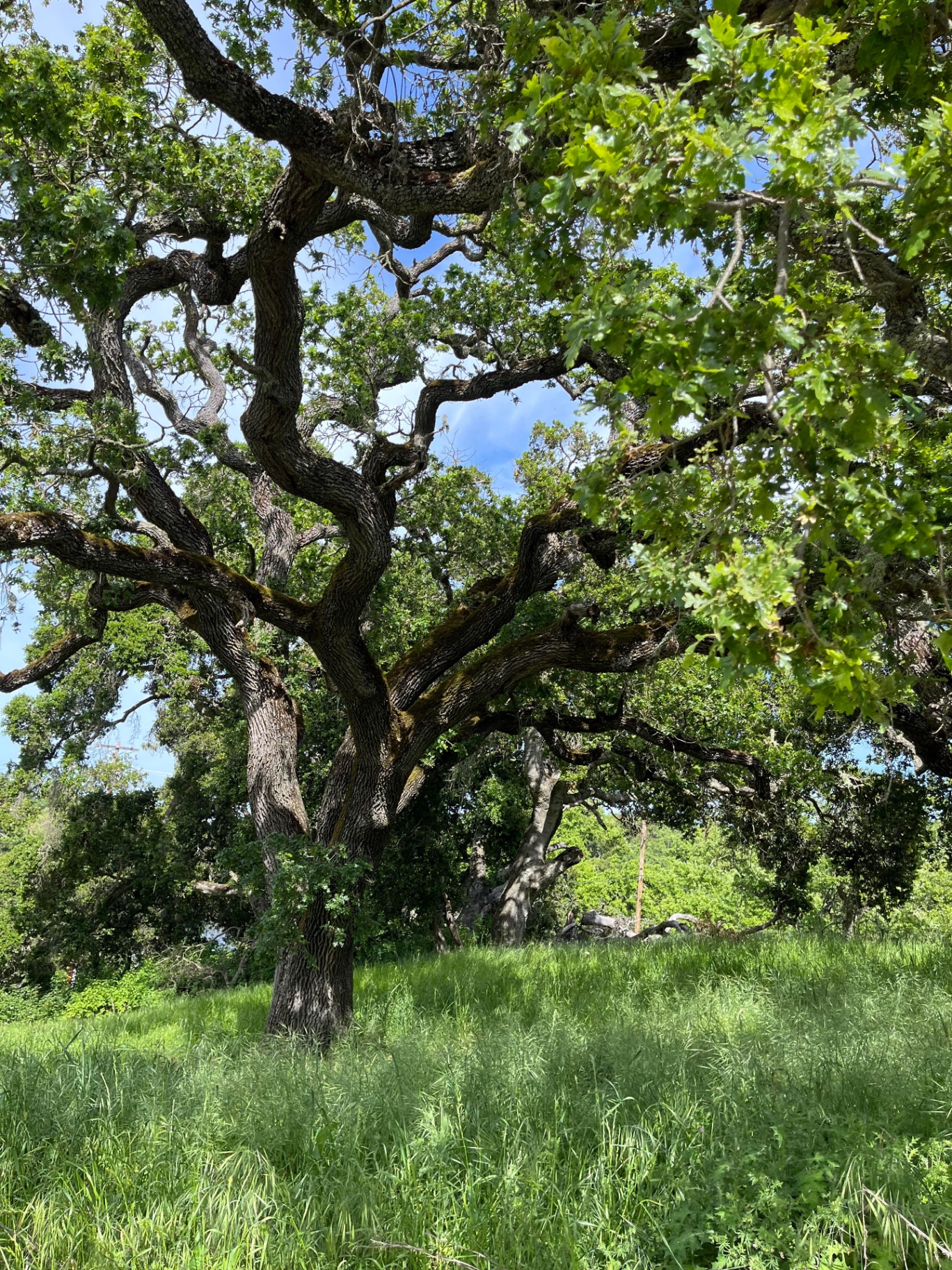
I have spent much of my career listening to trees.
As an ISA Certified Arborist (RM-7885BF), I have been trained to assess structure, biology, defects, and risk. We use data, standards, and experience to understand what a tree may reveal about its condition and its potential hazards. But after years of working among some of the most remarkable trees in our landscapes, I have learned that trees communicate in ways that extend beyond measurements and ratings. Every tree carries a history. Every wound tells a story. Every branch, cavity, and old scar is a record of survival.
Over the course of two years, I completed Level 2 tree risk assessments on approximately twelve hundred heritage trees throughout Santa Clara County Parks, including valley oaks, madrone, and tan oak. Those assessments were not simply inspections. They were conversations with some of the oldest residents of our valleys and forests, trees that had endured drought, fire, storms, changing landscapes, and generations of human activity.
The foundation for this work began with a vision developed by Don Rocha, who created Santa Clara County Parks Natural Resources Management Program. Don understood that the long term care of the park system’s trees required building internal knowledge and capability rather than depending primarily on outside contractors and vendors for every assessment. His vision was for Natural Resources Program coordinators to evaluate approximately one third of the park system’s trees annually, with assessments completed by October each year. Through that approach, the entirety of the county parks tree population could receive a Level 2 risk assessment on a three year cycle.
When Barry Hill and Don Rocha brought me into Santa Clara County Parks in 2016, they expressed the need for someone with my background as an ISA Certified Arborist to help lead the tree risk assessment program. They recognized that effective tree management requires more than identifying hazards. It requires understanding the ecological, cultural, and historical importance of the trees entrusted to our care.
That responsibility led me into the hills of Santa Clara County Parks on countless early mornings. Before the heat of the day settled in, I would walk the trails beneath the valley oaks, madrone, and tan oaks with the morning light filtering through the branches. I listened to birdsong, watched turkeys moving through the landscape, observed bobcats crossing familiar paths, and occasionally experienced the startling presence of a mountain lion reminding me that I was a visitor in a much larger ecosystem.
But the greatest encounters were always with the trees themselves.
Each tree I evaluated seemed to tell a different story. Some spoke of resilience, standing strong despite centuries of environmental pressures. Others revealed the signs of age and decline, reminding me that even the most magnificent organisms eventually face limitations. Some showed evidence of past injuries that had been compartmentalized and survived. Others carried structural concerns that required thoughtful decisions about public safety and preservation.
The challenge of arboriculture is that trees are not machines. They cannot simply be repaired, replaced, or managed according to a single formula. A heritage oak, a weathered madrone, or an aging tan oak is a living organism with its own history, its own responses, and its own place in the landscape.
Risk assessment is often misunderstood as a process of finding problems. In reality, it is a process of understanding relationships: the relationship between a tree and its environment, between public use and natural systems, and between preservation and safety. The goal is not to remove every tree that presents uncertainty. The goal is to make informed decisions that respect both the public and the tree.
The oldest trees continue to teach us patience. They remind us that growth happens slowly, that resilience is built over time, and that stewardship requires looking beyond immediate concerns. A tree that has stood for hundreds of years deserves more than a quick judgment. It deserves careful observation and informed management.
As I walked through Santa Clara County Parks evaluating these heritage trees, I realized that my role was not simply to assess trees. It was to help protect a living legacy.
The oldest trees keep trying to tell us something: our landscapes are not merely places we pass through. They are places we inherit, places we influence, and places we are responsible for protecting for those who come after us.
If we listen carefully, the trees will continue to guide us.