Why the Eucalyptus Needs to Come Down — and What Goes in Its Place
Blue gum eucalyptus is a fire-prone, allelopathic, hollow-limbed monoculture on much of the Bay Area's wildland-urban interface. Removing it is not vandalism. It is overdue restoration — and the replacement palette already exists.
Kyle D. Peczkowski
Board Certified Master Arborist & Urban Forester
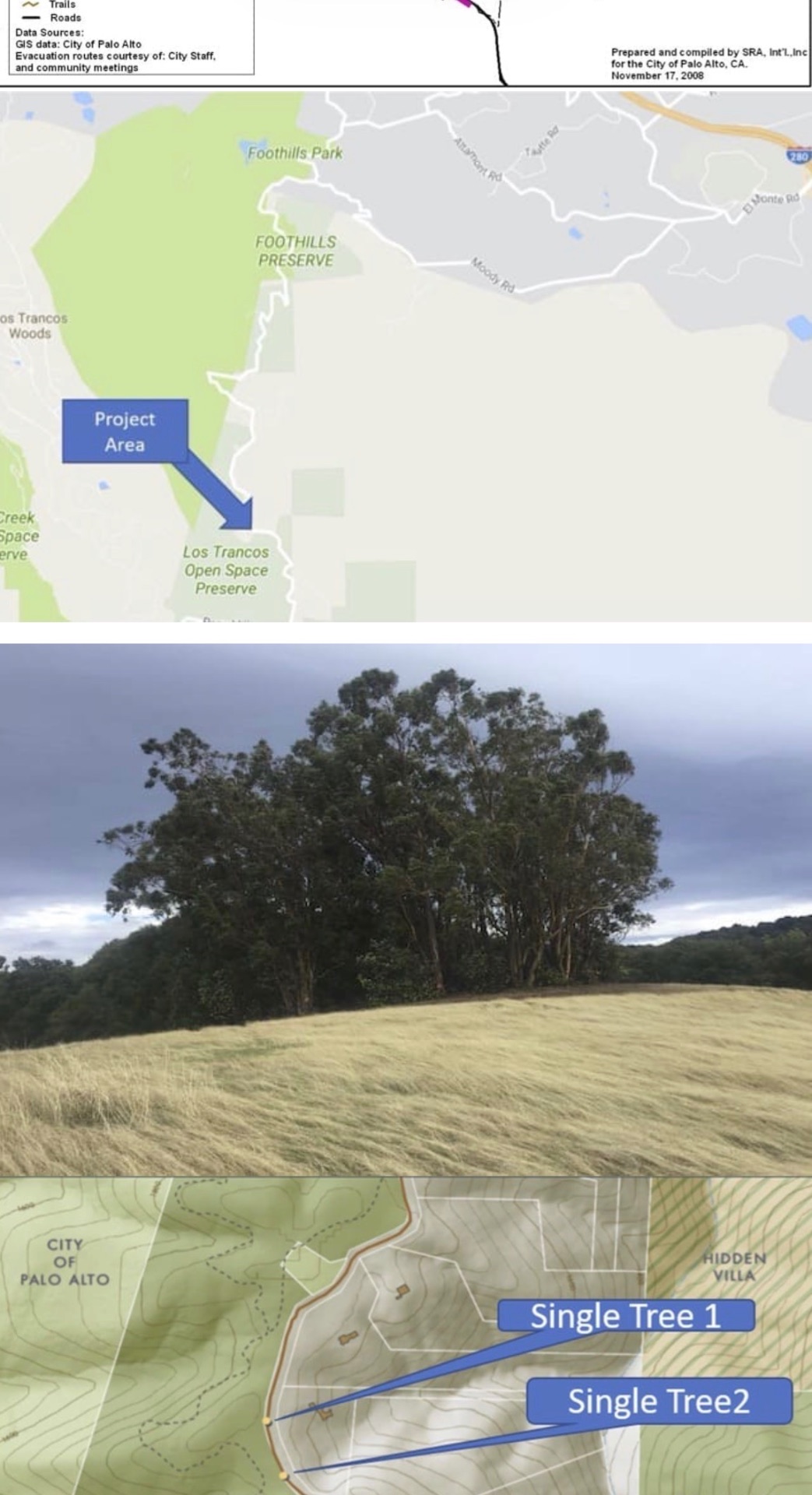
Every few years the conversation about eucalyptus removal on Bay Area hillsides reopens, and every few years the same objections arrive: the trees are beautiful, the monarchs use them, the groves are historic, removal is somehow a form of environmental violence. I want to make the practitioner's case for why the removal is not only defensible, it is the ecologically responsible move — and why we already know what to plant instead.
Blue gum (Eucalyptus globulus) was brought to California in the 1850s on the theory it would become the state's timber crop. It did not. What it became instead was a fire-carrier. The tree evolved with Australian fire regimes: it drops long ribbons of oil-rich bark, its litter suppresses understory competitors through allelopathy, and its crown chemistry produces volatile oils that behave, in a wildfire, like a fuel accelerant. The 1991 Oakland Hills fire — 25 deaths, 3,000 structures — burned through blue gum groves in a way that has been studied for thirty years and is not seriously contested in the fire-science literature.
The trees are also structurally poor. Blue gum sheds massive limbs without warning, particularly in dry-summer stress and after cold snaps. Every year on this side of the bay somebody's car, somebody's roof, sometimes somebody, is under one of those limbs when it comes down. The insurance industry has a name for these trees, and it is not a flattering one.
Under the canopy the picture is worse. Blue gum groves in California are near-monocultures. The allelopathic litter chemistry, the deep shade, and the moisture competition combine to produce a forest floor with very low native plant diversity. Monarch overwintering does occur in some coastal groves, and any removal plan on those specific sites needs to account for that — but the monarch argument is a site-specific consideration, not a species-wide veto.
So: what replaces it? The palette is not exotic. On the wildland-urban interface, the working list is coast live oak (Quercus agrifolia), valley oak (Q. lobata), California bay (Umbellularia californica) on the moister aspects, big-leaf maple (Acer macrophyllum) in the draws, western sycamore (Platanus racemosa) along the drainages, and California buckeye (Aesculus californica) as a structural understory. On drier south-facing slopes, toyon (Heteromeles arbutifolia), coffeeberry (Frangula californica), and manzanita species form a fire-adapted shrub canopy that carries far less crown fire than blue gum.
The replacement is not one-for-one in stature. A restored native slope will not have the 150-foot silhouette of the eucalyptus grove, and that visual change is a real loss to the people who grew up looking at those trees. It is the honest tradeoff, and it needs to be said out loud. What we get in exchange is a hillside that carries less fire, drops fewer limbs on cars, hosts more native pollinators and passerines, and supports an understory that behaves like California rather than like a stranded piece of Tasmania.
Practically, a good removal plan phases the work over five to ten years, treats stumps to prevent stump-sprout regrowth (blue gum resprouts vigorously), pre-plants the native replacement palette in the first two years of the sequence so canopy loss and canopy gain overlap, and uses the removed biomass on-site for erosion control and habitat structure rather than trucking it out. Done well, it is restoration, not deforestation. Done badly — clear-cut, no replanting, no stump treatment — it is a fire scar with a resprout problem, and it gives the objection its ammunition for the next cycle of the argument.
The eucalyptus is a nineteenth-century speculation that we have been managing around ever since. Bay Area cities have the technical capacity and the plant palette to close that chapter. It is a slow project. It is the right one.