Street Median Renovation and Street Tree Planning: Notes from a Denver Supervisor
A city and county of Denver supervisor walks through how median renovation and street tree planting are managed as one system — and what Bay Area counties can borrow from that integration.
Kyle D. Peczkowski
Board Certified Master Arborist & Urban Forester
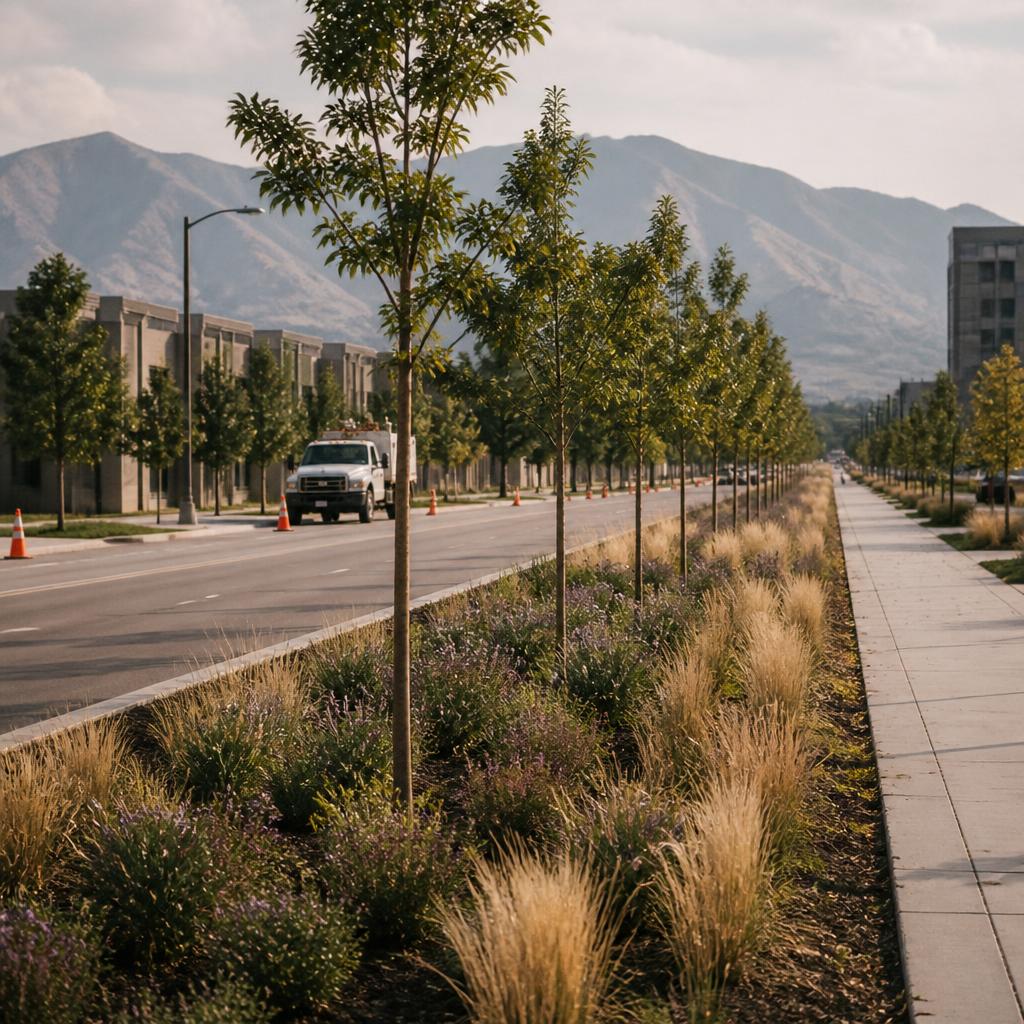
I spent a morning on the phone last month with a supervisor at the City and County of Denver who manages both street median renovation and street tree planning — the full corridor, from curb to curb, including the trees in the parking strip, the plants in the median, and the drainage that keeps both alive. It is the kind of role that barely exists in most California counties, where street trees belong to public works, medians belong to roads, and water belongs to utilities. Hearing it described as one job was instructive.
Denver's corridor work starts with a simple premise: the median is not a planter box in the road. It is the spine of the street, and it has to do stormwater work, traffic-calming work, heat-mitigation work, and aesthetic work at the same time. The street trees are not an amenity layered on afterward. They are the vertical structure that makes the median legible as a designed space rather than a traffic island.
The supervisor described a recent arterial renovation on a corridor that had been built in the 1970s: four lanes, narrow medians, cracked concrete, ash trees declining from emerald ash borer, and a drainage system that sent every rain event straight to the storm sewer. The redesign widened the median to a minimum of eight feet, lowered it six inches below the gutter line, cut curb inlets every two hundred feet, and planted it with a mix of native and adapted grasses, perennials, and small shrubs. The street trees — honeylocust and Kentucky coffeetree, replacing the ash — were placed in continuous soil volumes tied to the median rain garden so that root space and irrigation were one system, not two.
What struck me was how the maintenance contract was written. The same crew that maintains the median maintains the trees. They are trained to read tree stress, adjust irrigation zones, and spot pest issues before they become block-wide problems. In California I more often see a landscape contractor maintaining the median and a separate urban forestry contractor maintaining the trees, with a third party managing the irrigation controller. The handoffs alone guarantee that nothing gets optimized.
Denver also thinks about the median as a water-budgeting device. The lowered, planted median captures the first flush from the roadway, filters it through soil and root systems, and only sends overflow to the storm sewer. On a typical Denver corridor, that first-flush capture is measured in acre-feet per year. The street trees are the living pumps that move that water back into the atmosphere through transpiration. Without the trees, the median is just a bioswale. Without the median, the trees are just street furniture. Together they are a corridor-scale cooling and hydrology system.
The supervisor was candid about what makes this hard. Utility conflicts are the single biggest constraint — medians are where fiber, gas, electric, and storm lines converge, and every tree placement requires a conflict review. Snowplows set the minimum clearances. Salt load from winter deicing limits the plant palette. And public perception matters: drivers notice when a median goes from bare concrete to planted, and some will complain about visibility until the design proves itself.
The lesson for Santa Clara County is not to copy Denver's plant palette — honeylocust would be a poor fit for most of our summers — but to copy the integration. Our county roads and unincorporated corridors have the same fragmented ownership: roads, trees, drainage, and landscaping managed by different departments or different agencies. A project that should be one corridor redesign gets delivered as four separate contracts, and the result is a street that works for nobody.
The Denver supervisor's closing point was practical: start every corridor project with a single drawing that shows pavement, curb, median, trees, utilities, and drainage together. Do not let any one discipline draw their piece in isolation. The first drawing is where the integration happens, and if it is not integrated there, it will not be integrated in the field.
It is a modest idea — one drawing, one crew, one water budget — but it is the opposite of how most public agencies build streets. For a county trying to grow canopy cover, reduce heat islands, and manage stormwater on aging roads, that modest idea may be the most important one.