Correctional Facilities as Food System and Tree Nursery Hubs
Jails and prisons sit on thousands of acres of underused land. With the right partnerships, they could grow food, raise native trees, and train a workforce for the green economy.
Kyle D. Peczkowski
Board Certified Master Arborist & Urban Forester
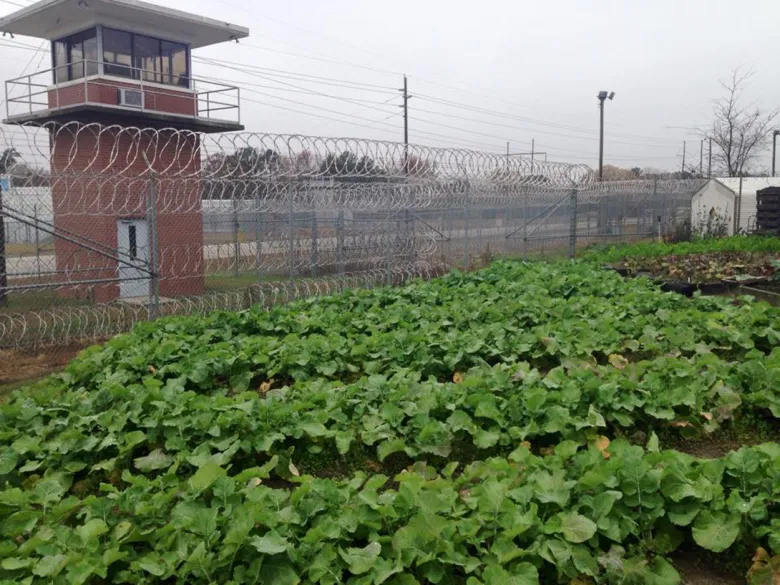
Correctional facilities are rarely described as assets for food security or ecological restoration, but they should be. Across California, county jails and state prisons occupy large parcels of land with open ground, unused rooftops, greenhouses waiting to be repaired, and a captive workforce looking for meaningful work. The question is not whether these sites can produce food and trees. The question is why we are not already treating them as infrastructure.
Start with the land. A typical county jail sits on ten to fifty acres, much of it lawn, gravel, or degraded turf. That land could be converted to raised vegetable beds, orchards, pollinator meadows, and container nurseries for native trees. A single medium-security facility could produce tens of thousands of pounds of vegetables annually and raise five to ten thousand native saplings for riparian restoration, urban forestry, and wildfire recovery. The output is real. The carbon math is favorable. The public benefit is measurable.
The workforce opportunity is just as significant. Incarcerated people need job training that translates to employment after release. Horticulture, irrigation, arboriculture, and nursery management are skilled trades with growing demand in every California county. A well-designed correctional program partners with community colleges, union apprenticeship programs, and local farms to offer certifications in food safety, nursery production, and small engine repair. The work gives participants a skill, a credential, and a sense of purpose that few other prison jobs provide.
There are already models. The Insight Garden Program, Roots of Success, and several county jail garden programs have shown that horticulture reduces recidivism and improves behavior inside facilities. Participants in garden programs report lower rates of violence, better relationships with staff, and stronger connections to family visiting days. The reason is not mysterious. Caring for living things is fundamentally different from the idleness that dominates prison life. It asks people to plan, observe, adapt, and take responsibility.
For a county natural resources program, the partnership is obvious. We need native plants. We need locally grown trees that are adapted to our soils and climate. We need a workforce pipeline for urban forestry and restoration. A correctional nursery could supply our riparian plantings, our schoolyard trees, and our wildfire recovery sites while giving participants experience in the exact work we want to hire for. It turns a liability, idle land and institutional cost, into a regional asset.
The food system connection is equally direct. County jails feed thousands of people every day. Most of that food is sourced through industrial distributors and arrives pre-portioned and heavily processed. A facility garden could supply fresh produce to the jail kitchen, reducing food costs and improving nutrition for incarcerated people and staff. Surplus produce could go to county food banks, senior centers, and school meal programs. The jail becomes a node in the local food web rather than a drain on it.
Design matters. A correctional farm or nursery cannot be a punitive work detail. It has to be voluntary, educational, and connected to a clear pathway after release. Security concerns are real but manageable. Hand tools, not power equipment, can be used in higher-security settings. Greenhouses and raised beds can be placed inside secure perimeters. Low-security facilities can run more expansive operations with fewer restrictions. The program should match the security level, not let security be an excuse for inaction.
Water and soil are the first technical questions. Most facilities have irrigation infrastructure that can be adapted. Soil may need remediation, especially on older sites with lead paint, heavy metals, or compacted fill. Start with soil testing and raised beds filled with clean compost. Use container nurseries to avoid soil quality issues entirely. Capture roof runoff for irrigation. The engineering is straightforward; the institutional will is the harder part.
Partnerships make or break the model. A successful program needs the sheriff or corrections department, the county parks or sustainability office, a community college or workforce board, a nonprofit with reentry expertise, and a buyer network for the food and plants. Each partner brings something essential. No single agency can do it alone. The best programs have a memorandum of understanding that spells out roles, outputs, and how participants transition into employment.
There is also a climate case. Local food reduces transportation emissions. Native tree nurseries support carbon sequestration and habitat connectivity. Composting food waste from the jail kitchen closes a loop. Solar-powered greenhouses and drip irrigation reduce resource use. A correctional facility operating as a regenerative campus is a powerful demonstration project for the rest of the county.
Critics will say this is too soft on crime or too expensive. The evidence says otherwise. Horticulture programs reduce recidivism, which saves far more money than the program costs. Fresh food lowers healthcare costs inside facilities. Local tree production reduces procurement spending for county planting projects. And the public safety benefit of people leaving custody with a trade, a work history, and a connection to the land is hard to overstate.
The vision is not decorative. It is practical. A correctional facility can be a food hub, a tree nursery, a training center, and a reentry pipeline all at once. It can produce the plants we need for climate resilience and the food we need for community health. It can give incarcerated people a reason to get up in the morning and a skill to leave with. The land is there. The need is there. The only missing piece is the decision to start.