Where Biochar and Ecological Restoration Actually Intersect
Biochar has been sold as a climate silver bullet, a soil amendment miracle, and a carbon-market commodity. In restoration practice, it's something more modest and more useful: a specific tool for a specific set of degraded sites.
Kyle D. Peczkowski
Board Certified Master Arborist & Urban Forester
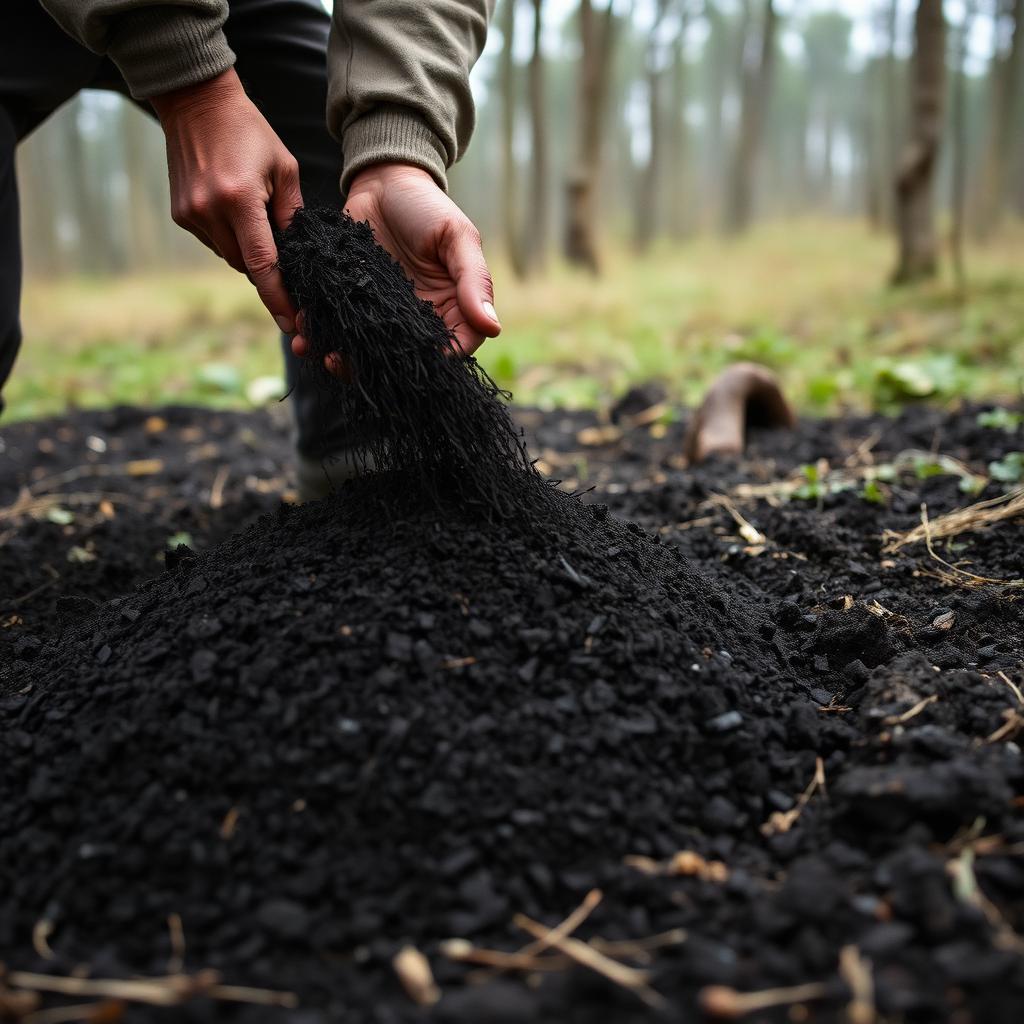
Biochar arrives in the restoration conversation with a lot of baggage. It has been marketed as a climate silver bullet, a soil-fertility miracle, and a tradable carbon commodity, sometimes by the same vendor in the same brochure. Practitioners who have to actually put material on the ground learn to filter the marketing out and ask a narrower question: on which specific sites, in which specific quantities, does biochar do restoration work that another intervention wouldn't do better?
The honest answer is: fewer sites than the vendors claim, more than the skeptics claim, and the sites where it works are identifiable in advance if you know what to look for.
Start with what biochar actually is. Pyrolyzed woody biomass — plant material heated in a low-oxygen environment until the volatile compounds cook off and what's left is a stable, porous carbon skeleton. The surface area of the resulting material is enormous. That surface area is the whole ecological argument: it hosts microbial communities, adsorbs and slow-releases nutrients, and holds soil moisture in a rooting zone that would otherwise dry out too fast.
The sites where that matters most in California restoration are compacted, low-organic-matter mineral soils where the natural soil structure has been degraded past the point where seeding alone will re-establish a plant community. Post-fire scars where the duff layer burned off and the surface soil hydrophobed. Old ranch roads and staging areas where fifty years of vehicle compaction have collapsed the pore structure. Former agricultural fields being brought back to native perennial grassland where the organic matter has been mined out over decades of tillage.
On those sites, biochar incorporated at 5 to 10 tons per acre into the top 15 centimeters — ideally co-applied with a native compost so the microbial community is delivered along with the habitat — measurably improves seedling establishment and early perennial cover. The effect is not subtle at year three. It is also not permanent in the sense the carbon-market brochures imply: some fraction of the biochar carbon is stable for centuries, some fraction turns over on decadal timescales, and the accounting is more honest when it says 'long-lived soil carbon amendment' rather than 'permanent sequestration.'
On the sites where biochar doesn't do restoration work, it is because the limiting factor was never soil physical structure or moisture retention. If the limiting factor is deer browse, biochar doesn't help. If the limiting factor is invasive annual grass competition, biochar doesn't help — in fact, on some sites it modestly favors the annuals over the natives in the first two years, because annuals are opportunistic and respond faster to any improvement in the seedbed. If the limiting factor is hydrology (dewatered wetland, incised channel, disconnected floodplain), biochar is beside the point.
There is also a sourcing conversation that the restoration community has not fully had. Biochar produced from waste woody biomass — hazardous fuels reduction thinnings, orchard removals, urban tree waste — is, on net, the version of the practice that makes ecological sense. Biochar produced from biomass grown specifically to be pyrolyzed is a much harder argument to defend on either climate or restoration grounds. In practice this means the restoration ecologist and the fuels-reduction crew are on the same team, using each other's outputs. That is a good outcome, and it is one of the few places in this field where the fire people and the restoration people have a shared line item.
The synthesis is unglamorous. Biochar is a specific tool that solves a specific soil-structural problem on specific site types, priced honestly, sourced from waste streams the fire program is already producing. It is not a climate strategy and it is not a soil miracle. Used correctly, on the sites where it fits, it is one of the more useful interventions available to restoration practitioners working on degraded mineral soils in California — and that, on its own, is enough to justify the material without any of the marketing.