Beyond Grass: Reinventing the Field of Play
Grass or synthetic turf? After years of debate, a better question emerges: what if California designed play surfaces for its actual climate, its children, and its future?
Kyle D. Peczkowski
Board Certified Master Arborist & Urban Forester
There is a question that has divided communities for decades.
Grass or synthetic turf?
It sounds like a practical question. An engineering question. A budget question.
But I believe it is the wrong question.
And when we spend years debating the wrong question, we guarantee ourselves the wrong answers.
Here in Santa Clara County, we've spent countless hours in public meetings discussing athletic fields. Parents want places for their children to play. Coaches need fields that can withstand year-round use. Cities face shrinking budgets, recurring drought, and increasing pressure to conserve water.
Natural grass or synthetic turf?
Back and forth.
Year after year.
Meanwhile, the climate keeps changing.
Perhaps the debate isn't stalled because the problem is difficult.
Perhaps it's stalled because we have confused tradition with necessity.
Natural grass is beautiful.
It is cool beneath our feet. It captures carbon. It supports living soil, insects, fungi, microbes, and the invisible ecosystem beneath every blade. Healthy soil isn't just dirt. It is one of the most complex living systems on Earth. It filters water, stores carbon, supports biodiversity, and quietly performs countless services that make life possible.
But maintaining sports-quality turf in California isn't natural.
It demands millions of gallons of irrigation. It requires constant mowing, fertilizing, aerating, reseeding, and, in many cases, herbicides and pesticides to suppress weeds and maintain a dense playing surface capable of surviving thousands of hours of use.
Those chemicals don't simply disappear.
Children spend hundreds of hours every year diving, sliding, breathing, and growing on these fields. Their developing brains and bodies are uniquely sensitive to environmental exposures. We know enough today to recognize that reducing unnecessary chemical exposure whenever possible is simply good public health.
Synthetic turf promises an escape from those challenges.
No watering.
Less maintenance.
More playing time.
It sounds almost perfect.
Until you touch it on a hot August afternoon.
Synthetic fields routinely become dramatically hotter than natural grass, creating heat islands that can make play dangerous during California summers.
Every slide releases tiny fragments of plastic.
Every season sheds microplastics into our waterways and environment.
Every decade or so, an entire field—tens of thousands of square feet of engineered plastic—must be removed and replaced, ultimately becoming waste.
So we've arrived at an extraordinary moment.
One option depends on intensive water use and chemical management.
The other depends on plastic.
Neither represents the future we say we want for our children.
But what if the future isn't hidden somewhere between these two choices?
What if it's somewhere beyond them?
Think about tennis.
No one argues there is only one authentic surface.
There is grass.
Clay.
Hard court.
Each creates a different style of play.
Each is still unquestionably tennis.
Volleyball thrives on sand.
Track athletes compete on specialized surfaces.
Sports evolve.
Only soccer seems trapped by history.
Modern soccer was born in England.
England has abundant rainfall and cool weather.
Grass made perfect sense.
California has a Mediterranean climate.
Increasing heat.
Recurring drought.
And a future that will almost certainly demand even greater resilience.
Why are we investing millions trying to recreate England?
Shouldn't California be designing California?
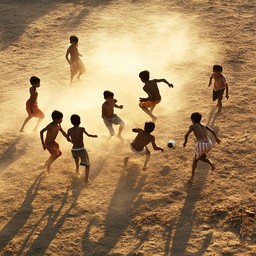
Around the world, children already play soccer on surfaces adapted to their local environment.
In regions where water is precious, sand fields are common.
Children don't love the game any less.
They still develop extraordinary skill.
They still compete.
They still dream.
The field does not define the sport.
The players do.
Now imagine something entirely new.
Not synthetic turf.
Not thirsty lawns.
Imagine surfaces inspired by living soil.
Engineered natural materials.
Sand blended with stabilizing minerals.
Clay technologies.
Locally sourced renewable materials.
Surfaces designed specifically for California's climate.
Cooler.
Safer.
Water-wise.
Free of microplastics.
Free of routine pesticide applications.
Imagine athletic fields that work with nature instead of against it.
And imagine what that means for our children.
Children deserve places that encourage movement without unnecessary environmental exposure.
They deserve cooler playing surfaces during hotter summers.
They deserve healthy soils that absorb rain instead of shedding polluted runoff.
They deserve communities willing to innovate instead of simply arguing.
Because this conversation has never really been about grass.
Or plastic.
It has always been about children.
It has always been about the world we are building for them.
Santa Clara County has long been recognized as one of the most innovative places on Earth.
We are home to the engineers who changed communication.
The scientists who transformed medicine.
The entrepreneurs who reimagined transportation, computing, and artificial intelligence.
Innovation is part of our identity.
So why would we accept a false choice when designing something as fundamental as where our children play?
What if the next great California innovation isn't another app?
What if it's a soccer field?
Imagine if Santa Clara County became the first community to say:
"We refuse to choose between water waste and plastic waste."
"We refuse to choose between pesticide exposure and microplastic exposure."
"We will invent something better."
That decision would ripple far beyond our county.
Communities across drought-prone regions of the world are asking exactly the same questions.
How do we create places where children can play safely while respecting the limits of our environment?
Someone will answer that question.
Why not us?
Why not here?
Innovation has never been about improving yesterday.
Innovation is imagining what tomorrow requires before everyone else sees it.
The Office of Sustainability has an opportunity not simply to weigh in on turf options, but to redefine what sustainable recreation looks like for the twenty-first century.
When future generations look back, I hope they won't remember that we argued over grass versus plastic.
I hope they'll remember that this community had the courage to ask a better question.
Because every breakthrough in history began the same way.
Someone stopped accepting the choices they had been given.
And imagined another one.
Thank you.